

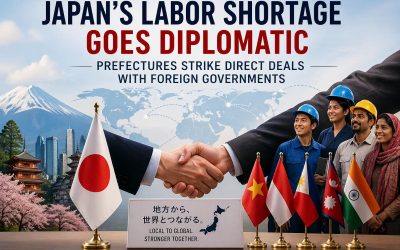
An NHK survey has revealed that 20 of Japan’s 47 prefectures have signed memorandums of understanding (MOUs) with foreign governments in a bid to attract overseas workers — a sign of how acute the country’s labor shortage has become.
Japan’s foreign worker population hit a record 2.57 million as of late October last year, yet the distribution remains deeply uneven. Roughly 40 percent of those workers are concentrated in Tokyo and its three neighboring prefectures — Kanagawa, Saitama and Chiba — leaving rural and regional areas struggling to compete for talent. With Japan’s working-age population shrinking due to its aging demographic crisis and persistently low birth rate, the pressure on local economies to find sustainable labor solutions has never been greater.
In response, a growing number of prefectures are bypassing purely private-sector recruitment channels and forging direct ties with governments abroad. The 20 prefectures that have signed such agreements include Hokkaido, Miyagi, Ibaraki, Mie, Osaka, Ehime and Oita. Their overseas partners span a range of fast-growing labor-exporting nations, including Vietnam, Indonesia, India and Nepal — countries with young, increasingly skilled workforces and strong interest in expanding overseas employment opportunities for their citizens.
Most of the accords have been concluded since 2023 and span sectors facing some of the sharpest worker deficits in Japan: agriculture, tourism, construction and nursing care. Under the agreements, prefectures typically commit to improving both working and living conditions for incoming workers — covering areas such as housing support, language assistance and community integration — while also pledging regular information exchanges with partner governments to ensure transparency and accountability throughout the recruitment process.
For prefectures, the value of these formal agreements goes beyond logistics. Ehime Prefecture notes that having an official MOU helps ease the anxieties of source countries, reassuring them that their citizens will be properly supported — a crucial factor in a competitive global market where Japan is vying against South Korea, Australia, Canada and European nations for the same pool of workers. Ibaraki Prefecture, meanwhile, says the agreement gives it a formal platform to market its strengths and stand out amid intensifying inter-regional competition within Japan itself.
Tokai University Professor Manjome Masao warns, however, that prefecture-level efforts alone may not be enough. As competition for foreign workers stiffens, individual companies are increasingly hitting the limits of what they can achieve on their own, he says, making local government support all the more critical. But he also cautions that wide disparities exist between prefectures in their capacity and resources to attract overseas talent — and that without stronger coordination and support from the central government in Tokyo, those gaps risk widening further, leaving smaller or less affluent regions at a significant disadvantage.
With Japan’s labor shortfall projected to deepen in the coming decades, the push to build structured, government-backed pipelines for foreign workers is likely to accelerate — and the model being pioneered by these 20 prefectures may well become the national norm.


 Japan Lifts Ban on Lethal Arms Exports?