

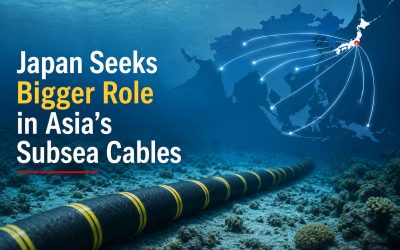
Japan is advancing its strategic position in Asia’s critical subsea cable infrastructure as artificial intelligence and data center expansion drive unprecedented demand for transoceanic connectivity. Japan subsea cables Asia initiatives reflect Tokyo’s recognition that submarine cable networks have become essential strategic assets for economic competitiveness and technological leadership in an increasingly data-dependent region.
Japan subsea cables Asia development comes as the region’s data center operators urgently require enhanced connectivity to support the rapid proliferation of artificial intelligence applications, cloud computing services, and massive data processing operations. The demand transformation is fundamental: traditional undersea cable infrastructure designed for conventional internet traffic is insufficient for the bandwidth-intensive requirements of modern AI systems and hyperscale data centers that now anchor digital economies across Southeast Asia, South Asia, and the broader Indo-Pacific region.
Japan subsea cables Asia AI data centers strategy builds on more than 25 years of operational experience in submarine cable networks. Japanese companies and government agencies have identified this sector as a critical infrastructure domain where Tokyo can exercise geopolitical and economic influence. The subsea cable ecosystem directly impacts telecommunications capacity, data sovereignty, and national resilience in an era where digital infrastructure determines competitive advantage.
Japan subsea cables Asia expansion involves both private corporations and government participation. Japanese telecommunications companies, equipment manufacturers, and financial institutions are coordinating investment in new cable routes, capacity upgrades, and advanced technologies required to handle AI workload traffic patterns. These initiatives position Japan as a central node in Asia’s digital infrastructure hierarchy, ensuring Japanese companies maintain leadership in submarine cable design, manufacturing, and operations.
Japan subsea cables Asia AI data centers integration requires coordinated development across multiple stakeholder groups. Regional governments, international telecommunications carriers, and technology infrastructure companies must align on technical standards, routing decisions, and capacity planning to meet explosive demand projections. Japan’s experience and technical expertise position the country as a natural regional leader in this critical infrastructure transition.
The Japan subsea cables Asia strategic initiative demonstrates how infrastructure investment directly translates to technological influence and economic advantage. As artificial intelligence reshapes global computing requirements, the nations controlling subsea cable networks will exercise disproportionate influence over digital commerce, data flows, and technological development across the region for years to come.

