

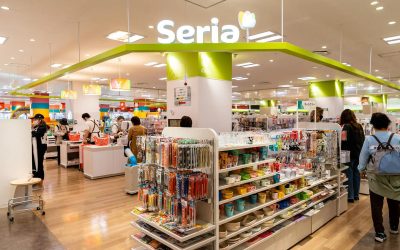
Seria, one of Japan’s best-known 100-yen shop chains, is making a high-stakes bet that its low-price model will become even more attractive as inflation reshapes the country’s discount retail sector.
While rivals such as Daiso and Can Do are expanding into higher price tiers, Seria is sticking firmly to the traditional 100-yen shop formula that helped it thrive during Japan’s long era of deflation. The company believes consumers, squeezed by rising living costs, will increasingly seek out retailers that still offer simple, uniform pricing on everyday essentials.
“Inflation is an opportunity for us,” Seria President Eiji Kawai said in an interview.
That confidence reflects a pivotal shift in Japan’s retail landscape. For decades, 100-yen shops grew by catering to budget-conscious shoppers in an economy defined by stagnant prices and cautious spending. But now, with inflation driving up raw material, transport, and labor costs, discount chains are being forced to rethink how long they can preserve ultra-low prices.
Seria, however, sees this moment as a chance to strengthen its identity. At its more than 2,000 stores across Japan, customers buy a wide range of low-cost daily goods, including snacks, stationery, kitchen items, and household cleaning products. According to Kawai, demand is already spilling over from competitors as shoppers react to higher prices elsewhere.
Seria’s strategy stands out because it runs against the direction of much of the market. Daiso, the sector’s dominant player, along with Can Do and others, has increasingly introduced merchandise above the 100-yen level, betting that consumers will pay more for wider variety and better quality. Seria is doing the opposite. It is betting that in an inflationary economy, consistency itself becomes a selling point.
“Because we have stayed with the 100-yen model, customers are finally recognizing that value,” Kawai said. He argued that inflation will weigh on both households and rival retailers, leaving Seria in a position to benefit from what he called “survivor benefits.”
Even with these diverging strategies, Japan’s low-cost retail market continues to grow. According to Teikoku Databank, total sales in the sector are estimated to have risen 2.7 percent to ¥1.11 trillion in fiscal 2025, up from about ¥600 billion a decade ago. That growth suggests Japanese consumers are still deeply attached to affordable variety stores, even as the business model itself comes under pressure.
Yet the move toward higher price tiers is not without risk. Retailers that push beyond the traditional 100-yen format may find themselves competing more directly with established players such as 3COINS and Muji, which already have stronger positions in the slightly more premium segment, said Daisuke Iijima, a researcher who follows the industry.
“If Seria ever abandons 100 yen, it could signal the end of the one-coin business model,” Iijima said.
Still, holding the line on price will be increasingly difficult. Kawai acknowledged that Seria faces serious risks from rising procurement costs, especially as disruptions in global energy markets threaten supplies of oil and petrochemicals. That matters because many products sold in Japan’s 100-yen shops are made from plastic and other oil-derived materials.
The closing of the Strait of Hormuz has added to those concerns, raising fears of higher material and shipping costs across multiple industries. Suppliers are already seeking price increases, Kawai said, and those pressures could begin hitting Seria as early as next month.
If costs continue to rise, the company may respond by reducing the quantity of packaged goods such as garbage bags, while larger plastic products could be removed from shelves altogether. In other words, Seria may try to preserve the 100-yen price point not by raising prices outright, but by adjusting product specifications and assortment.
That approach could still resonate with many shoppers. According to Risa Tanihana, an analyst at Daiwa Securities, Japanese consumer spending is becoming increasingly polarized. Some consumers are willing to pay more for premium, high-quality goods, while becoming even more determined to save money on basic, disposable, or frequently replaced items.
“This is a kind of survival-of-the-fittest phase where weaker players may be weeded out,” she said.
For now, Seria says it remains committed to protecting the price point that defines its brand. Kawai said the company would make “every possible effort” to maintain the 100-yen business model. If inflation eventually makes that unsustainable, Seria may consider a gradual increase, possibly to around ¥110 before tax, while still preserving a uniform low-price structure.
Until then, the company is betting that discipline, not diversification, will win over Japanese consumers.
“If things are tough for us, they are even tougher for our competitors,” Kawai said. “Our strategy is to remain standing to the very end.”
For SEO, this version is stronger because it repeatedly and naturally includes high-value search phrases such as Seria, Japan’s 100-yen shops, 100-yen store model, inflation, discount retail, and rising prices. A strong SEO title for publication would be:
Seria Doubles Down on Japan’s 100-Yen Shops as Inflation Pushes Rivals to Raise Prices

 7-Eleven to Close Hundreds of Stores Across North America This Year