

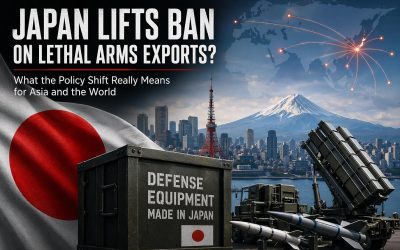
Tokyo — For decades, Japan built its postwar identity on restraint. Its pacifist stance, rooted in Article 9 of the Japanese Constitution, limited not just the use of force but also the export of military equipment. That long-standing posture is now undergoing a quiet but consequential transformation.
In late 2023 and into 2024–2026, under Prime Minister Fumio Kishida, Japan began easing restrictions on defense exports—including, for the first time, allowing the export of certain lethal systems under tightly defined conditions. The move signals a strategic pivot that reflects rising regional tensions, alliance obligations, and a recalibration of Japan’s role in global security.
This is not a full abandonment of pacifism—but it is the most significant reinterpretation of it in generations.
What Exactly Changed?
Japan did not suddenly open the floodgates to global arms sales. Instead, it revised its long-standing Three Principles on Transfer of Defense Equipment and Technology, originally adopted in 2014.
The latest changes allow:
- Export of lethal defense equipment produced under license from partner countries (notably the United States)
- Transfers to countries involved in joint development projects
- Limited exports aimed at strengthening allied deterrence, particularly in Europe and the Indo-Pacific
A notable early case: Japan approved the export of Patriot missile components to the United States, indirectly supporting Ukraine’s defense without sending weapons directly into a conflict zone.
Why Now? The Strategic Drivers
1. Rising Regional Threats
Japan faces an increasingly complex security environment:
- North Korea’s expanding missile program
- China’s military assertiveness in the East China Sea
- Tensions around Taiwan
These dynamics have pushed Tokyo to rethink its strictly defensive posture.
2. Alliance Pressure and Burden-Sharing
As a key ally of the United States, Japan is under growing pressure to contribute more actively to collective security. Allowing arms exports enhances interoperability and strengthens defense supply chains among allies.
3. Defense Industry Survival
Japan’s domestic defense sector has long struggled due to limited scale and export bans. Opening export channels:
- Improves economies of scale
- Encourages innovation
- Keeps critical manufacturing capabilities viable
What Japan Still Cannot Do
Despite the shift, Japan’s policy remains highly restrictive compared to major arms exporters:
- No exports to active conflict zones (with narrow exceptions via intermediaries)
- Strict case-by-case approvals
- Continued emphasis on defensive systems, not offensive weaponry
- Strong parliamentary and public scrutiny
This is evolution—not a wholesale militarization.
Regional and Global Implications
Indo-Pacific Security Architecture
Japan’s move aligns it more closely with partners like the U.S., Australia, and India. It strengthens a network of deterrence aimed at balancing China’s growing influence.
European Defense Supply Chains
Japan’s industrial capacity—especially in advanced components—offers a new source of resilience for NATO-aligned supply chains strained by ongoing conflicts.
Normative Shift in Pacifism
Perhaps the most profound change is conceptual: Japan is redefining what pacifism means in an era of geopolitical competition. The emphasis is shifting from non-participation to responsible contribution.
Domestic Debate: A Nation Divided
The policy change has not gone uncontested.
Supporters argue:
- It enhances national security
- Strengthens alliances
- Reflects geopolitical reality
Critics warn:
- It erodes the spirit of Article 9
- Risks entanglement in foreign conflicts
- Lacks sufficient public mandate
Public opinion in Japan remains cautious, with many citizens wary of moving too far from the country’s pacifist identity.
What This Means for Businesses and Analysts
For defense contractors, policymakers, and global investors, the implications are tangible:
- New market opportunities for joint defense projects involving Japanese firms
- Supply chain diversification for allied militaries
- Increased importance of regulatory compliance and export controls in Japan
For analysts and researchers, Japan is now a critical case study in how middle powers adapt security doctrines without abandoning foundational principles.
Bottom Line
Japan has not “abandoned” its pacifism—but it has reinterpreted it for a more volatile world. By cautiously allowing lethal arms exports under strict conditions, Tokyo is stepping into a more assertive security role while trying to preserve the moral framework that has defined it since World War II.
For observers across Asia and beyond, the question is no longer whether Japan will change—but how far it is willing to go.


 Seria Doubles Down on Japan’s 100-Yen Store Model as Rivals Raise Prices